

Why Static Diagrams Fail You in System Design Interviews
A box-and-arrow diagram can't tell you whether your design works. Here's what interviewers are probing for, and why drawing tools can't help you practice it.

4 min read
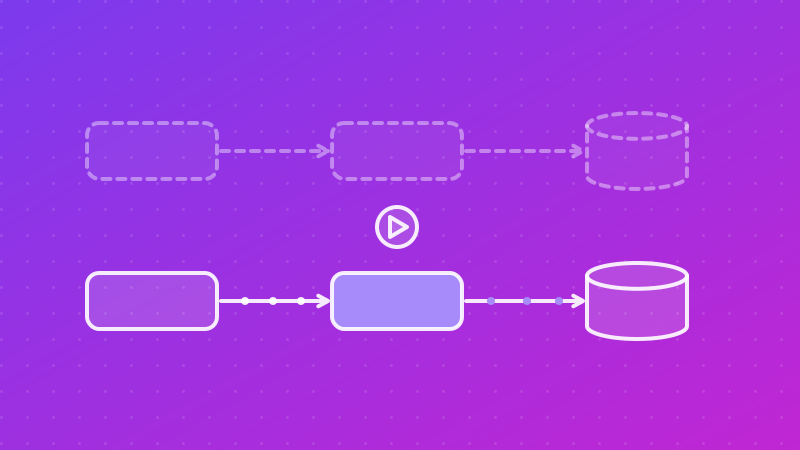
Most people prepare for system design interviews by drawing. They open a diagramming tool, drag out a load balancer, three app servers, a cache and a database, connect them with arrows, and move on to the next problem. After twenty problems the diagrams all look competent.
Then the interview happens, and the questions have nothing to do with the drawing.
The diagram is the setup, not the answer
A senior interviewer spends maybe five minutes on your boxes. The rest of the hour is spent somewhere else entirely:
- "Your cache is in front of the database. What happens on a cache miss storm after a deploy?"
- "You've got a queue here. What's the consumer lag when traffic triples?"
- "This load balancer is round-robin. One of your servers is at 90% CPU and the others are idle. Why?"
- "You lose an availability zone. Walk me through the next thirty seconds."
None of these are answerable from a diagram, because a diagram has no time dimension. It shows what components exist and what talks to what. It says nothing about what happens. The arrows carry no traffic, the queues have no depth, the nodes have no capacity, and nothing ever fails.
That gap is the whole interview.
Static tools teach you the vocabulary, not the intuition
There's a specific failure mode that comes from practicing with drawing tools. You learn the pattern language — "add a cache", "shard the database", "put a queue in front of it" — without the causal model underneath. You can name the components. You can't predict the behaviour.
It shows up in a very recognisable way. The candidate adds a cache because caches are good, then can't explain the invalidation strategy. They add a queue to "handle spikes", then can't say what happens when the consumer is slower than the producer for an hour. They pick round-robin because it's the default, without knowing it's the wrong default for long-lived connections or heterogeneous request costs.
Interviewers are calibrated to spot exactly this. Pattern recall reads very differently from intuition, and the follow-up question is where the difference surfaces.
What intuition actually requires
You build a causal model of a system the same way you build one for anything else: by changing an input and watching the output. That requires three things a static diagram can't give you.
Time. Queue depth, consumer lag, retry storms, cold-start cascades and backpressure are all behaviours over time. A snapshot can't represent any of them.
Load. A design that's obviously correct at 100 requests per second and obviously broken at 100,000 is the normal case, not the exception. If you never turn the traffic dial, you never find the breaking point — and "where does this break?" is the most common senior-level follow-up there is.
Failure. Every interesting property of a distributed system is a property of how it degrades. You cannot reason about a replica set until you've watched what happens when the primary goes away.
Practice the follow-up, not the drawing
The practical shift is small. Whatever tool you use, stop when the diagram is done and start asking the interviewer's questions of your own design:
- Pick the bottleneck before you're told. Every design has one. Name it out loud. If you can't, you don't understand your own design well enough to defend it.
- Triple the traffic in your head. What saturates first? What queues up behind it? What starts timing out three hops upstream?
- Kill one component. Not the obvious one — kill the thing you assumed was always available. Service discovery. The cache. One replica.
- Justify every default. Why that load balancing algorithm, that replication mode, that queue depth? "It's the default" is the answer that ends senior interviews early.
If you can answer those four for your own design before anyone asks, the interview stops being an interrogation and starts being a conversation between two engineers — which is what the format was always trying to be.
Where ArchiDepth fits
This is the gap ArchiDepth was built for. The canvas produces a design, but the point is what comes after: press play and the design carries actual traffic. Load balancers route by their configured algorithm. Nodes saturate and push back. Rate limiters drop requests when the bucket empties. Replicas fall behind their primary. When you turn the traffic up, something breaks — and you get to see which thing, in what order, and why.
That's the same loop the follow-up questions are testing. Practicing it directly beats practicing the drawing.